
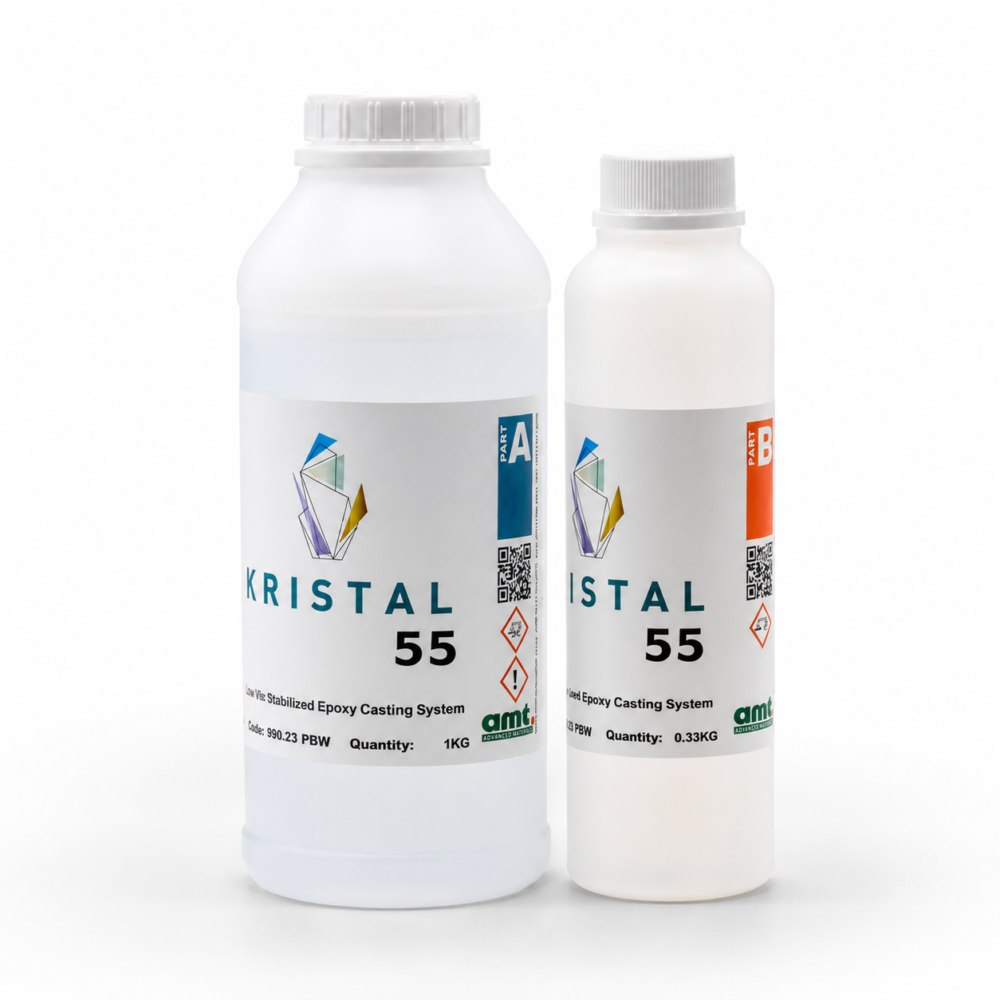

You can download the technical and safety data sheet below.
TECHNICAL SHEET
SAFETY DATA SHEET
Processing Recommendations
For best results:
- Store and use the materials at an ambient temperature of approximately 23°C with relative humidity below 85%.
- Warmer temperatures will reduce the working/pot life and may influence the maximum casting thickness.
- If the room temperature is above 25°C, reduce the maximum casting thickness by approximately 50%, or as required, to help prevent excessive exothermic heat.
- To help minimise air bubble entrapment, Part A and Part B may be pre-warmed to approximately 28°C–30°C before mixing.
- Allow the casting to cure at approximately 18°C–23°C.
- KRISTAL™ resin systems can also be vacuum de-aired to further minimise trapped air.
Mixing & Application
Always
- Measure Part A Resin and Part B Hardener accurately according to the manufacturer’s specified mixing ratio.
- Use an accurate digital gram scale.
- Mix thoroughly for approximately 3–5 minutes using a flat paddle mixer.
- Scrape the sides and bottom of the mixing container several times while mixing.
- Pour the mixed resin into a second clean container and mix again for approximately 60 seconds before casting.
This “mix, pour, mix” technique helps ensure any unmixed resin or hardener remaining on the sides or bottom of the first container is properly incorporated, reducing the risk of tacky areas or streaking in the cured casting.
Allow adequate time for the resin to fully cure before sanding, polishing or using the finished item.
Always wear suitable safety equipment and a dust mask when sanding or polishing cured resin.
Avoid
- Applying resin onto oily or contaminated surfaces.
- Applying resin onto damp or wet surfaces.
- Whipping or beating the resin while mixing, as this introduces unnecessary air bubbles.
- Exceeding the manufacturer’s recommended casting thickness.
- Casting excessive volumes in one pour.
Safety & Handling
Epoxy resins and hardeners are chemical products and should always be handled with appropriate care.
- Work in a well-ventilated area.
- Avoid breathing fumes. A suitable NIOSH-approved respirator is recommended where appropriate.
- Wear nitrile gloves to minimise skin contact.
- Barrier creams may also be used to help minimise skin exposure.
- If accidental skin contact occurs, wash thoroughly with soap and water or a suitable hand cleaner.
- Do not use solvents to clean epoxy from your skin.
Important – Exothermic Reaction
Epoxy resin systems are exothermic, meaning heat is generated when the resin and hardener are mixed and begin to cure.
Larger volumes generate more heat and can cure considerably faster.
If mixed or poured in volumes greater than recommended, the resin can generate enough heat to:
- Melt plastic mixing containers
- Cause skin burns
- Damage surrounding materials
- Potentially ignite combustible materials
Always follow the recommended casting thickness and reduce pour depth when working in temperatures above 25°C.
If mixed resin begins to become excessively hot, carefully move it to a well-ventilated open-air area and avoid breathing any fumes.
Pouring
- Pour the resin into the lowest point of the mould or project and allow it to naturally seek its own level.
- Pouring slowly and uniformly helps minimise air bubble entrapment.
- Do not exceed the recommended maximum casting thickness.
- When casting in multiple layers, allow the previous layer to cure and return to room temperature before pouring the next layer.
- A propane torch may be used carefully to dissipate surface bubbles. Keep the flame continuously moving and never hold it in one place, as excessive heat can damage or burn the resin surface.
Pot Life & Curing Time
Epoxy casting resins are mass-sensitive.
Larger volumes generate more heat through the exothermic reaction, resulting in a shorter pot life and faster cure.
Thinner castings generate less heat and may therefore take longer to cure.
Ambient temperature also has a significant effect on working and curing times.
- Typical curing time at approximately 23°C: 24–72 hours
- Temperatures below approximately 18°C may cause delayed or inhibited curing.
Always allow the casting to cure completely before sanding, polishing or putting it into service.
Adding Colour
KRISTAL™ 55 can be coloured using compatible epoxy colouring products such as:
- Epoxy pigments
- So-Strong™ pigments
- UVO™ pigments
- Metallic powders
- Pearlescent powders
- Phosphorescent / glow-in-the-dark powders
These can be used to create anything from solid colours and translucent effects to metallic, pearlescent and glow finishes.
Release Agents
For moulds or non-porous surfaces where adhesion needs to be prevented, compatible release agents such as Ease Release™ 200, Ease Release™ 205 or Ram Wax may be used.
These are particularly useful when casting against surfaces such as:
- Metal
- Glass
- Melamine
- Acrylic sheeting
Removing Uncured Epoxy
If epoxy needs to be removed before it has cured:
- Scrape away as much excess material as possible using a suitable paint scraper.
- Remaining residue may be removed from suitable surfaces using acetone or isopropyl alcohol.
Always follow appropriate chemical handling and safety precautions when using cleaning solvents.
Important Product Information
Always follow the manufacturer’s recommended mixing ratios, maximum casting thickness, processing temperatures and safety precautions.
Full product specifications, processing instructions and safety information can be downloaded from the Technical Data Sheet and Safety Data Sheet provided below.
How Much Resin Does My Mould Need?
Not sure how much KRISTAL™ 55 to mix for your mould? You can easily work it out using water and a digital scale.
- Place your empty mould on a digital scale and set the scale to zero.
- Fill the mould with water to the level you would normally fill it with resin.
- Note the weight of the water in grams.
- Multiply the water weight by 1.1 to estimate the total amount of mixed KRISTAL™ 55 required.
Formula:
Water weight × 1.1 = Total mixed resin required
Then Work Out Part A & Part B
KRISTAL™ 55 is mixed at 100 parts Part A to 33 parts Part B by weight.
Once you know the total amount of mixed resin required:
Part A = Total mixed resin × 100 ÷ 133
Part B = Total mixed resin × 33 ÷ 133
Example
If your mould holds 100g of water:
Step 1 – Work out total resin required:
100g × 1.1 = 110g total mixed resin
Step 2 – Work out Part A:
110g × 100 ÷ 133 = 82.7g Part A
Step 3 – Work out Part B:
110g × 33 ÷ 133 = 27.3g Part B
So you would mix approximately:
82.7g Part A + 27.3g Part B = 110g total
Allow a Little Extra
We recommend making approximately 5% extra resin to allow for a small amount remaining in the mixing cup and on your mixing tools.
For example:
110g × 1.05 = 115.5g total resin
Then:
Part A: 115.5 × 100 ÷ 133 = 86.8g
Part B: 115.5 × 33 ÷ 133 = 28.7g
Important: Once you have measured your mould using water, make sure the mould is completely dry before pouring epoxy resin, as moisture can affect the finished casting.