
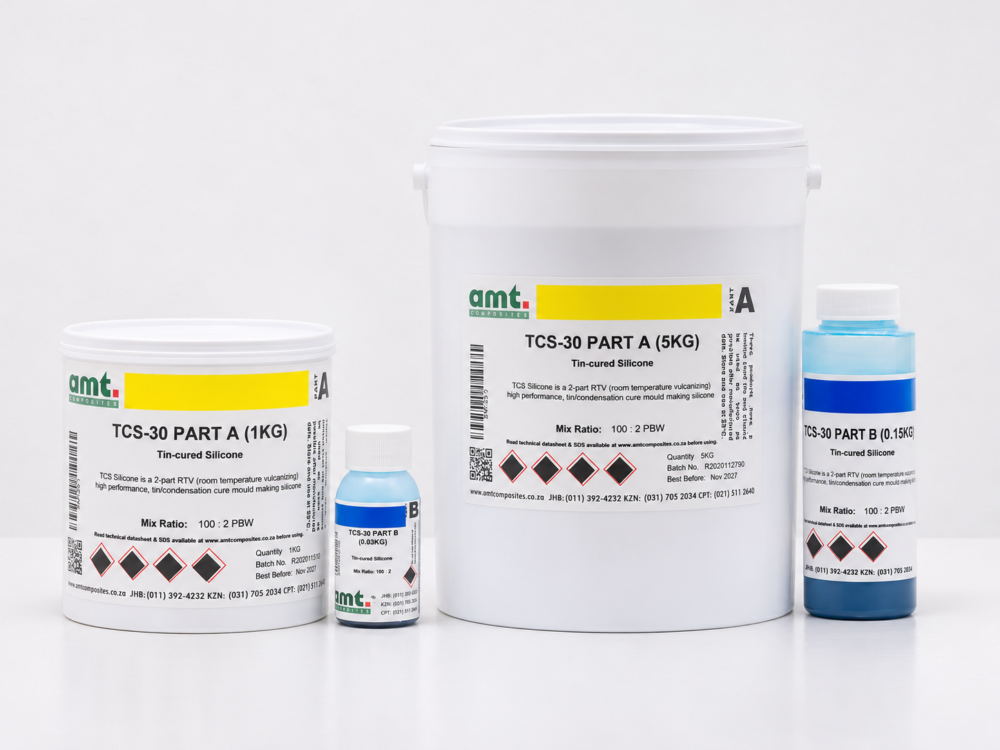
Art & Crafts : Silicone TCS – 30

Price range: R265.00 through R1,305.00 (incl. VAT)

TCS-30 Tin Cure Silicone Rubber – Mould Making Silicone

Professional Two-Part RTV Silicone | Shore A 30 | Mould Making & Casting

TCS-30 is a high-performance, two-part, room-temperature curing (RTV) silicone rubber manufactured by AMT Composites. This tin/condensation cure silicone is designed for creating flexible, durable and detailed moulds for a wide variety of casting applications.

Suitable for poured block and cavity moulds as well as brush-on mould making, TCS-30 can reproduce intricate surface details and is ideal for creative, craft and industrial mould-making projects.

Key Features & Benefits

  • Shore A 30 hardness – Flexible silicone with good tear strength.
  • Excellent detail reproduction – Suitable for detailed moulds and intricate designs.
  • Room-temperature curing – No special heating equipment required for standard curing.
  • Versatile applications – Suitable for poured and brush-on silicone moulds.
  • 40-minute working time – Allows time for careful mixing, pouring and bubble removal.
  • 24-hour demoulding time – At the recommended room temperature of 23°C.
  • Compatible with various casting materials – Including gypsum plaster, cement, resin, wax and soap.
  • Optional silicone thinner – Can reduce viscosity for easier pouring and improved flow into detailed areas.

Technical Specifications

Property Specification
Product TCS-30 Tin Cure Silicone
Silicone Type Two-part RTV, tin/condensation cure
Mixing Ratio 100:2 (Part A : Part B)
Measurement Method By weight
Pot Life / Working Time Approximately 40 minutes
Demoulding Time 24 hours
Recommended Curing Temperature 23°C
Hardness Shore A 30 ±2
Viscosity 20,000 CPS
Tear Strength 23 N/mm
Elongation at Break 350%
Linear Shrinkage 0.3%
Specific Gravity 1.21

Mixing Instructions

Important: All mixing ratios are measured by weight, not volume.

  1. Stir Part A and Part B separately before measuring to ensure any settled ingredients are properly incorporated.
  2. Weigh the required amount of Part A into a clean mixing container.
  3. Add Part B at a ratio of 2% of the Part A weight.
  4. Mix thoroughly for approximately 3 minutes, scraping the sides and bottom of the container.
  5. Transfer the mixture into a second clean container and stir again.
  6. Avoid vigorous mixing, as this can introduce unnecessary air bubbles.
  7. For best results, vacuum-degas the silicone before pouring.
  8. Pour slowly in a thin stream into the lowest point of the mould housing, allowing the silicone to flow naturally around the model.

Pot Life / Working Time – 40 Minutes

TCS-30 has an approximate pot life of 40 minutes, allowing sufficient working time for mixing, vacuum degassing and pouring the silicone into your mould housing.

Important: The 40-minute working time starts once Part A and Part B are mixed together.

Increasing the catalyst percentage above the standard 2% will reduce the available working time.

Demoulding Time: 24 hours at 23°C (room temperature).

Mixing Ratio Examples

Part A – Silicone Part B – Catalyst
100 g 2 g
250 g 5 g
500 g 10 g
1,000 g 20 g
5,000 g 100 g

Please note: Always measure the correct catalyst quantity. Do not automatically use the entire bottle of Part B supplied with your kit.

The catalyst level may be increased up to 4% for faster demoulding, but this reduces the available working time.

Optional Silicone Thinner

TCS-30 can be used with a compatible silicone thinning fluid, available separately in 500 g and 1 kg quantities. Silicone thinner reduces the viscosity of the silicone, helping it flow more easily into intricate areas and assisting with reducing trapped air bubbles.

Recommended maximum addition: 10% by weight.

Adding thinner will proportionally reduce the Shore A hardness and tear strength of the cured silicone. Customers should test their required dosage before producing a full mould. Silicone thinner is optional and is not required for standard TCS-30 mixing.

Suitable Casting Materials

TCS-30 moulds can be used with a wide range of casting materials, including:

  • Gypsum plaster and gypsum-based casting materials
  • Cement and concrete
  • Epoxy, polyurethane and polyester resins
  • Wax and candle-making materials
  • Soap
  • Low-temperature melting alloys

Important: Concrete and other abrasive casting materials can wear down mould details more quickly than non-abrasive materials such as wax and plaster.

Curing & Demoulding

Allow the silicone to cure for 24 hours at 23°C before demoulding.

AMT recommends that the silicone is not cured below 23°C.

For certain polyurethane resin and rubber casting applications, additional post-curing for 4–6 hours at 80°C can help remove residual moisture and alcohol produced during curing. Allow the mould to cool to room temperature before use.

Cleaning & Storage

  • Clean finished moulds with mild soap and water.
  • Rinse thoroughly and allow to dry completely.
  • Store moulds on a flat surface in a cool, dry environment.
  • Assemble multi-part moulds before storing to help retain their shape.
  • Keep unused silicone components tightly sealed.
  • Store uncured materials away from direct heat, ignition sources and foodstuffs.

Safety & Handling

  • Work in a well-ventilated area.
  • Wear suitable protective gloves and safety goggles.
  • Avoid contact with skin and eyes.
  • Avoid breathing vapours or mist.
  • Wash hands thoroughly after handling.
  • Keep containers sealed when not in use.
  • Keep out of reach of children.
  • Do not ingest.

First Aid: For eye or skin exposure, rinse with plenty of water for at least 15 minutes and seek medical advice if discomfort occurs. If swallowed, do not induce vomiting and contact a medical professional or poison centre immediately.

Although the supplied MSDS does not classify the finished product as a dangerous substance or mixture under the referenced CLP classification, appropriate protective precautions must still be followed.

Available Sizes

  • 1 kg TCS-30 Kit – Part A silicone and Part B catalyst.
  • 5 kg TCS-30 Kit – Part A silicone and Part B catalyst.

Optional Add-On Products:

  • Silicone Thinner – 500 g
  • Silicone Thinner – 1 kg

Silicone thinner is sold separately.

Stock Availability & Pre-Orders

Please note: This product is supplied on a pre-order basis.

We do not always keep TCS-30 silicone or silicone thinner in stock. Products are ordered from our supplier according to demand.

Please allow approximately 2–4 working days for supplier procurement, subject to availability, before your order is ready for dispatch or collection. Courier transit time is additional.

Customers are encouraged to plan their mould-making projects accordingly.

Pre-Order, Stock Availability & Pricing

Please note: This product is supplied on a pre-order basis.

We do not always hold stock of this product. Items are ordered from our supplier according to availability and customer demand.

  • Supplier Lead Time: Approximately 2–4 working days, subject to availability, before dispatch or collection.
  • Pricing: Prices are subject to change without prior notice due to supplier price adjustments, availability and other related costs.
  • Price Confirmation: The price paid at checkout will be honoured for confirmed and fully paid orders. Any price changes will apply to new orders only.
  • Availability: Should an item become unavailable after an order has been placed, we will contact you to discuss the available options.

We recommend placing orders in advance to avoid delays with your mould-making projects.

Important Disclaimer

Technical specifications and processing recommendations are based on information supplied by supplier. Actual curing times and mould performance may vary depending on temperature, mixing accuracy, additives and intended application.

Customers are responsible for testing the product to confirm suitability for their specific mould-making and casting requirements. For full handling, safety and technical information, please refer to the manufacturer’s Technical Data Sheet (TDS) and Material Safety Data Sheet (MSDS).

x
SKU: N/A Category: Tags: , , ,

MSDS – Technical

Safety Sheet

Vacuum Degassing – Important Information

For best results, the use of a vacuum chamber and vacuum pump is recommended when working with TCS-30 silicone.

During mixing, air bubbles can become trapped in the silicone. These bubbles may affect the surface finish, detail reproduction and overall quality of your finished mould.

Vacuum degassing helps remove trapped air before the silicone is poured.

Manufacturer’s recommendations:

  • Vacuum Level: 29 inHg (inches of mercury).
  • Expansion During Degassing: Allow space for the silicone to expand up to 5 times its original volume.
  • When to Degas: After thoroughly mixing Part A and Part B, and before pouring into the mould housing.
  • Working Time: TCS-30 has an approximate pot life of 40 minutes, so mixing, degassing and pouring should be completed within the available working time.

Can TCS-30 be used without a vacuum chamber?

Yes, it can be mixed and poured without vacuum equipment, but trapped air bubbles may remain in the silicone and affect the finished mould. For best results without vacuum equipment, mix slowly to minimise air incorporation and pour the silicone in a thin, continuous stream into the lowest point of the mould housing.

Compatible silicone thinner can also be added to help reduce viscosity and improve flow into detailed areas. AMT specifies a maximum addition of 10% by weight. Adding thinner reduces the cured silicone’s hardness and tear strength.

Please note: A vacuum chamber is not included with the silicone kits and must be purchased separately if required.

No Vacuum Chamber? Silicone Thinner Can Help!

For best results, AMT recommends using a vacuum chamber to remove trapped air bubbles from TCS-30 silicone before pouring.

Don’t have a vacuum chamber? You can still make silicone moulds without one!

Adding a compatible silicone thinner (sold separately) can help by:

  • Reducing the thickness (viscosity) of the silicone.
  • Allowing trapped air bubbles to escape more easily.
  • Improving flow around intricate designs and fine details.
  • Making the silicone easier to pour into mould housings.

Recommended Usage: Up to a maximum of 10% silicone thinner by weight, as specified by AMT.

Important: Adding thinner will reduce the Shore A hardness and tear strength of the cured silicone. Silicone thinner assists with bubble reduction but does not guarantee a completely bubble-free mould.

For best results without a vacuum chamber, mix gently, avoid whipping air into the silicone and pour slowly in a thin stream into the lowest point of the mould housing.

Available Silicone Thinner Sizes: 100 g, 500 g and 1 kg – sold separately.

Brush-On Mould Applications – Silicone Thixo

TCS-30 can also be used for brush-on mould making, including vertical surfaces.

For brush-on applications, a compatible silicone thixotropic additive (Thixo) can be added to increase the viscosity of the silicone and help prevent it from running down vertical surfaces.

AMT recommended additions by weight:

Thixo Addition Consistency
0.5% Thick
1% Thicker
2% Thickest – Maximum Dosage

Silicone Thixo is different from Silicone Thinner. Thixo thickens the silicone for brush-on applications, while thinner reduces viscosity for poured moulds.

Recommended Silicone Coverage When Pouring

For poured block and cavity moulds, AMT suggests covering the model with at least 10 mm of silicone.

Pour the silicone slowly in a thin stream into the lowest part of the mould housing, allowing it to flow around the model and self-level.

The amount of silicone required will depend on the dimensions, shape and complexity of your mould.

Mould Care & Long-Term Storage

The lifespan of a TCS-30 silicone mould depends on the casting materials used and how frequently the mould is used.

  • Abrasive materials such as concrete can wear down mould details more quickly.
  • Non-abrasive materials such as wax and plaster are generally gentler on mould surfaces.
  • Clean moulds using mild soap and water, rinse thoroughly and allow to dry completely.
  • Store moulds on a level surface in a cool, dry environment.
  • Reassemble multi-part moulds before storage to help maintain their shape.
  • AMT also recommends casting plaster into the mould before long-term storage to help extend mould library life.

SIZES

1KG, 5kg